Unsteady loading
How waves, turbulence and shear drive time-varying loads on tidal rotors and wave devices, and why quasi-steady models get the fatigue answer wrong.
Edinburgh, Scotland 55°57′N 003°11′W
Quantifying the unquantifiable to drive innovation in renewable energy.
Head of Modelling & Testing, Mocean Energy · PhD, University of Edinburgh
I work on marine hydrodynamics, which covers two things: the behaviour of the sea itself, meaning the waves, tides, currents and turbulence at a given place, and the loads that flow puts on a structure, whether moored or fixed to the seabed. Sometimes the question is simply what the sea is doing. Sometimes it is whether a structure will survive twenty years. Either way the models have to run through thousands of sea states and stay honest enough to design against. Nearly a decade of this in academia, eight years in industry, and lately a second brief: making the case for where AI genuinely earns its place in an engineering business.
I lead modelling and testing at Mocean Energy, an Edinburgh-based developer of hinged-raft wave energy converters, where I head the research and development of the technology and keep the technical work aligned with what the business actually needs. The job runs the full arc: floating body hydrodynamics, marine resource assessment, optimisation and the statistical treatment of wave data, through to the numerical tools and test campaigns that decide whether a machine survives the sea and pays for itself. I line manage, mentor, and do enough project management to keep it all moving.
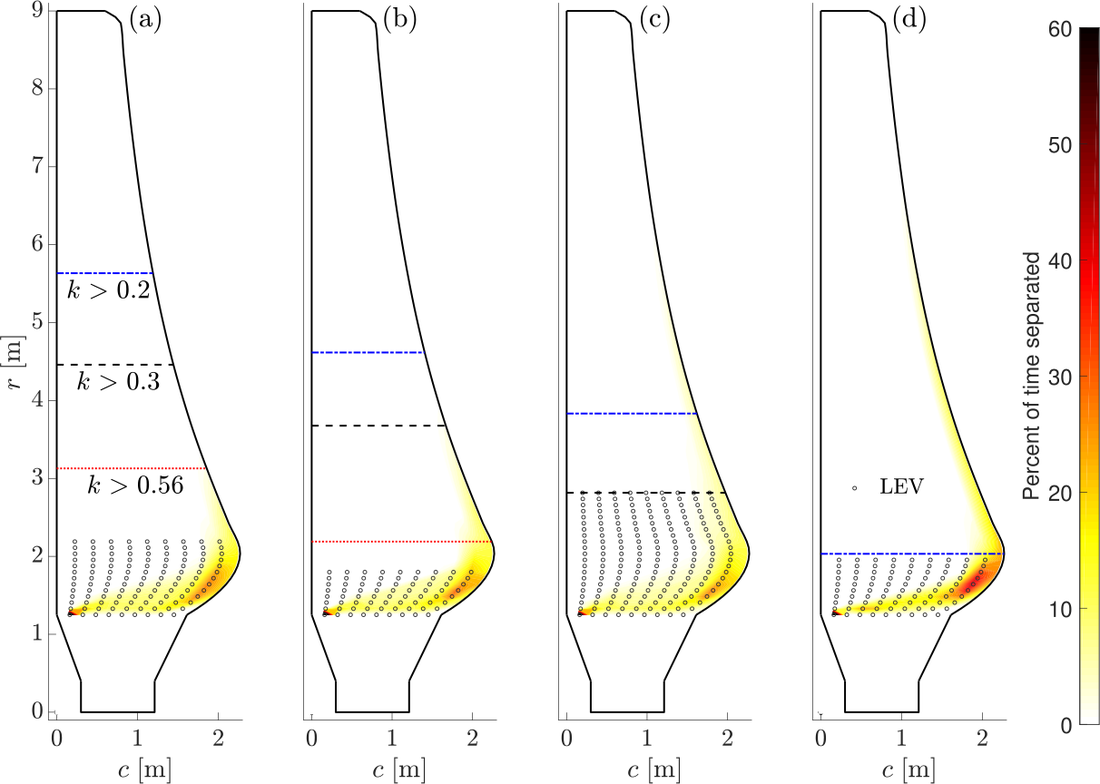
I hold a PhD from the University of Edinburgh, where my thesis, Unsteady hydrodynamics of tidal turbine blades, examined how waves, turbulence and shear combine to load a rotor far beyond what steady theory predicts. That work produced transTide, an open-source low-order model for unsteady blade loading, and it still shapes how I think about the problem: cheap, physically honest models beat expensive ones you can't run enough times.
Alongside the hydrodynamics I have taken on an advisory role championing the uptake of AI across the company: building practical expertise with both frontier and open-weight models, working out where they genuinely help an engineering business and where they are a liability, and keeping current in a field that moves month to month. It sits naturally next to my research interest in interpretable surrogate models and data-driven load prediction: in both cases the question is how to keep the physics in the loop when the model is learned rather than derived.
Where the academia and the industry actually went.
Mocean Energy · Edinburgh
Leading the research and development of wave energy converter technology, working across teams so the technical advances line up with commercial objectives.
Mocean Energy · Edinburgh
Hydrodynamic and numerical modelling of hinged-raft wave energy converters.
University of Edinburgh
Co-supervising MSc projects in tidal turbine blade hydrodynamic modelling, over three summers.
alongside MoceanPrivate consultancy
Delivered a bespoke numerical model for a wind energy start-up, adapting the solver built during my PhD to their application.
alongside MoceanUniversity of Edinburgh · Institute for Energy Systems
Understanding unsteady processes such as dynamic stall, where a leading-edge vortex raises performance until it detaches, and improving the analytical models that predict vortex growth and pinch-off.
EPSRC studentshipScottish Institute for Solar Energy Research · Edinburgh
Industrial placement as a graduate technologist: test-site commissioning, data acquisition and control strategy, side-by-side testing of a novel solar water heater, and an investigation of the UK PV resource.
University of Edinburgh
Master's project: ocean wave propagation in shallow waters: a Fortran finite-difference solver for shallow and intermediate depths, more accurate than the conventional approach, with applications to tsunami propagation and tidal-current resource assessment. I refactored it to Python in 2026, and it still lives in MEng_Project.
Stevenson College · Edinburgh
The route back in: maths, physics and chemistry from the ground up, taken to get on to the engineering degree.
Kounomiya Junior High School · Japan
A year teaching English in a Japanese junior high school before turning to engineering. Still speak some of the language.
Every renewable energy sector I have worked in, and what the work was.
Graduate technologist at the Scottish Institute for Solar Energy Research: test-site commissioning, a novel solar water heater trial and an investigation of the UK PV resource. Still current work: the Mocean device carries solar, so the resource and its capture are part of the day job.
PhD on the unsteady hydrodynamics of tidal turbine blades, the two most cited papers in my record, and transTide, still used by other researchers.
Head of Modelling and Testing at Mocean Energy: hinged-raft converter hydrodynamics, energy flux methods, extreme wave statistics and the test campaigns behind them.
Consultancy for a wind energy start-up, and research on hybrid floating wind and wave platforms and the co-location of wave and offshore wind for North Sea electrification.
They meet in one place: a wave energy converter, solar and battery storage working as a single system to power off-grid applications, where the whole point is that no one source has to carry the load on its own.
Four threads that run through most of the research and the code.
How waves, turbulence and shear drive time-varying loads on tidal rotors and wave devices, and why quasi-steady models get the fatigue answer wrong.
Blade-element momentum, potential flow, shallow-water and analytical unsteady theory: models fast enough to run through thousands of sea states, accurate enough to trust.
Surrogate and data-driven models for hydrodynamic prediction, built so the physics stays legible rather than disappearing into a black box.
Energy flux methods, hybrid wind–wave platforms, wave farm design and the operational economics that follow from the hydrodynamics.
Hydrodynamics first; the rest is what makes it useful.
The core of what I do, and it runs in two directions: characterising the sea itself, meaning waves, tides, currents and turbulence, and working out what that flow does to a structure, moored or fixed to the seabed. Methods run from analytical unsteady theory through potential flow to full CFD, validated against tank tests and sea trials rather than taken on faith.
Taking a device from concept hydrodynamics to a defensible power, load and cost case.
I lead the case for AI inside the business: where it earns its place, where it does not, and how to tell. Hands-on with both frontier and open-weight models, and keeping current in a field that changes monthly.
Enough of it to keep the technical work moving.
Selected peer-reviewed journal articles and conference papers, plus both theses. Full list and citation metrics on Google Scholar.
Open-source models and research outputs. More at github.com/gabscarlett.
Low-order numerical model predicting the unsteady loading of tidal turbine blades under combined wave and current conditions. The successor to my PhD-era solver.
Interpretable machine learning for yacht resistance prediction: a study in keeping learned hydrodynamic models physically readable.
Shallow-water and phase-resolving wave solvers from my master's project. The 2015 Fortran alongside a 2026 Python refactor of the 1D shallow-water solver: vectorised NumPy, RK4 with CFL-adaptive stepping. The thesis PDF is in the repository.
Research outputs and analysis code from my doctoral work on unsteady tidal turbine blade hydrodynamics at the University of Edinburgh.
Cycling, trail running and open water swimming, mostly in the Tweed Valley, the Lake District and whatever cold water is nearest.
Two Fred Whitton Challenges, Etape Caledonia and the Tour o' the Borders on the bike; the Tweed Valley Ultra, three Glentress trail halfs, the Edinburgh Half and the tide-limited Scurry around Cramond Island on foot, with times, from my own GPS data. Plus open water swimming at Wardie Bay.
Always happy to talk about marine hydrodynamics, numerical modelling, or where machine learning genuinely helps in ocean engineering.